
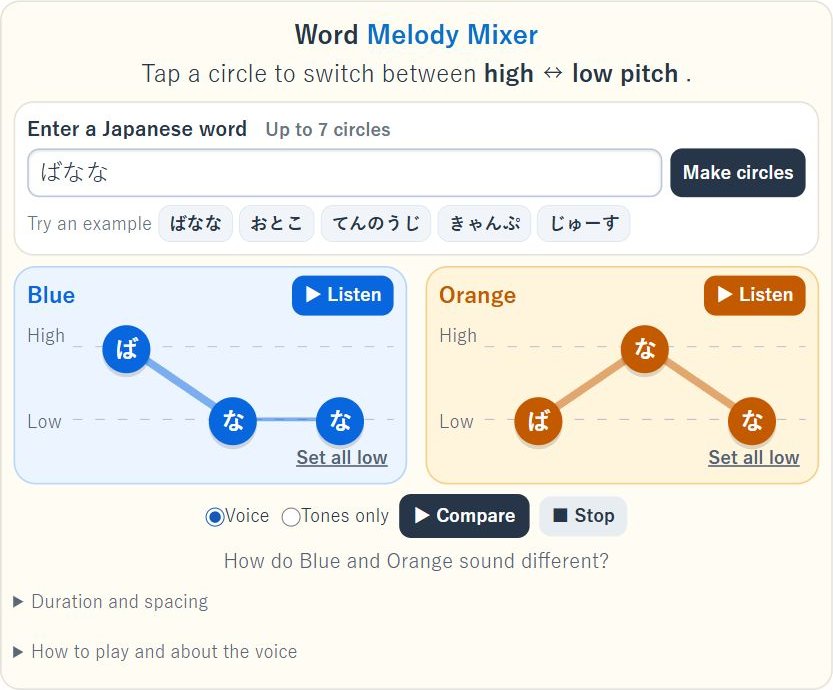
The controls are in English. This activity explores Japanese words and pitch; the example words and voice remain in Japanese.
Word Melody Mixer

The same Japanese word can sound different when its pitch changes.
Make two pitch patterns and listen to the difference.
What you can try
- Listen to a voice
- Compare two patterns
- Create your own reading
Let’s try it!
Word Melody Mixer
Tap a circle to switch between high ↔ low pitch .
How do Blue and Orange sound different?
Duration and spacing
How to play and about the voice
Tap a circle to move its pitch up or down. Listen to Blue and Orange separately, or play both in sequence.
Each Japanese sound unit, or mora, gets one circle. きゃ, しゃ and びゅ each use one circle; ん, っ and ー each use one too. っ creates a short pause, and ー extends the preceding vowel.
Japanese voice samples are joined together at high or low pitch. Adjust sound duration and gaps separately. The starting patterns, including ばなな, are examples for experimenting with sound; they do not model a regional dialect.
For parents and teachers
Split Japanese words into sound units, change their pitch and compare the results. Use familiar words or names to explore how speech sounds. The activity can also introduce discussion of regional and shared ways of speaking Japanese.
Blue and Orange are two freely editable patterns. Their initial pitches are playful examples, rather than correct answers for a particular dialect or standard pronunciation. Discuss differences between regions, homes and speakers without treating those differences as mistakes.
The input supports up to seven morae. Combinations such as しゃ, きゃ and びゅ count as one each; ん, っ and ー count separately. Individual processed samples do not sound exactly like natural conversation. Use them to focus on and experiment with pitch.